The Science of Speed: Why You Have Under 3 Seconds
You know the feeling: the phone rings, it’s a hot lead, and your team scrambles. In restoration, speed is everything, and that race starts the millisecond a homeowner clicks your link.
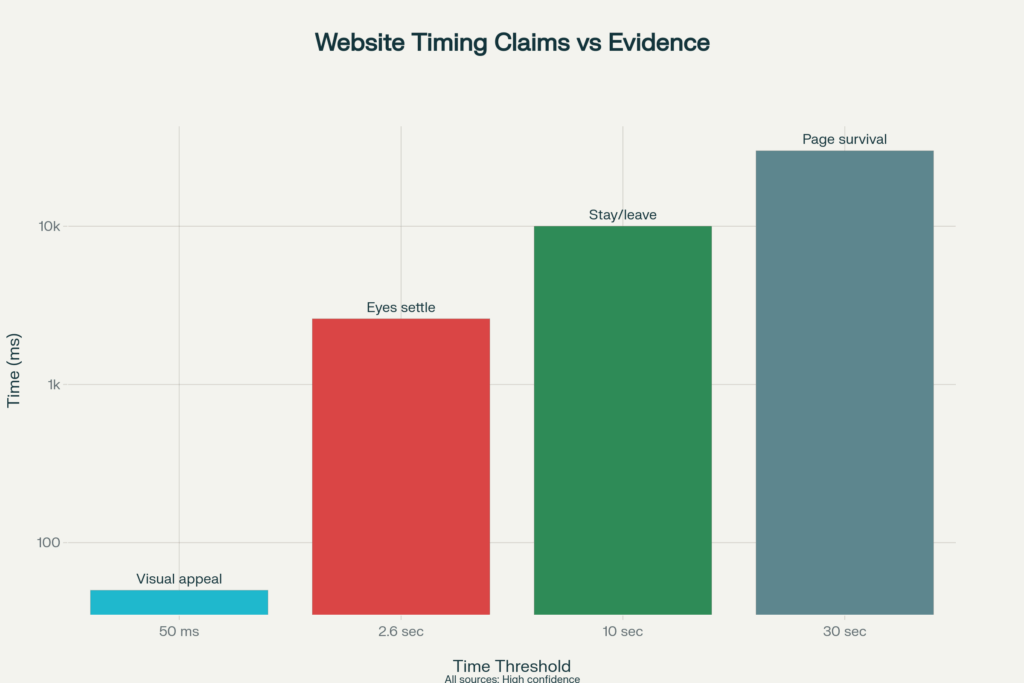
Forget the old “7-second rule.” Modern UX research tells a much harsher truth, especially for restoration website trust factors.
- 0.05 Seconds (50 Milliseconds): This is all the time a visitor’s brain needs to form a subconscious judgment about your site’s aesthetic appeal. This is pure, unconscious visual trust [1]. If your design looks dated, confusing, or low-quality, the race is over before it begins.
- 2.6 Seconds: The eyes of the homeowner settle on the few key areas that hold the most weight: your company logo, the main headline, and the navigation menu [3]. This is your total window to convey who you are and why they should trust you.
- 10 Seconds: If you haven’t delivered value, authority, and a clear path forward by this point, the majority of visitors will bounce [4]. In a crisis, this time pressure is amplified by loss aversion, they can’t afford a mistake, so they default to the first site that feels safe and authoritative.
The verdict? You don’t have time to tell a story below the fold. You must front-load every single reason a homeowner should choose you.
If you are too lazy to read the whole blog post, here’s a summary 🙂
Quick Start: Your 3-Second “Do-This-Now” Blueprint
A homeowner facing a flooded basement or fire damage is in crisis. They are not browsing; they are seeking a trusted responder. The research is clear: you have less than 3 seconds before they decide to stay or hit the back button.
Hand this list to your web designer today. If your site doesn’t pass these 10 points on mobile, you are losing jobs to your competitors right now:
- LCP $\le$ 2.5 Seconds: Your site must feel instant. Use a mobile-first speed audit immediately to compress your hero image and defer non-critical scripts [17, 18].
- Sticky Phone Number: Place your clickable phone number in a sticky header that is visible 100% of the time. Do not make them search.
- Urgent Headline & Proof: Use a high-contrast headline (e.g., “Emergency Water Damage? 1-Hour Response Guaranteed”) and a subhead with immediate authority proof (IICRC Certified, Licensed & Insured).
- Instant Trust Badge Row: Dedicate a row above the fold to authority logos: IICRC, Restoration Expertise Seal, BBB, and Insurance Logos [7].
- Social Proof Strip: Show your star rating and high review count (4.2★+, 50+ reviews) prominently near the phone number [5].
- High-Contrast “CALL NOW” CTA: Use a bright, high-contrast button that is the primary focus in the hero section.
- Real Before/After Carousel: Stop using stock photos. Display a small, fast-loading carousel of real project photos to build instant credibility [9].
- 24/7 Reassurance: Place “24/7 Emergency Service” and your guaranteed response time (e.g., “60-Minute Arrival”) twice, in the hero section and the sticky footer [10].
- Local Proof: Show your service area map or a list of neighborhoods you serve to leverage proximity [9].
- Schema Markup: Ensure your site uses LocalBusiness and FAQ schema to win more space and authority in Google’s search results.
The Restoration Trust Equation: 10 Signals That Convert
When a pipe bursts or a kitchen fire leaves a mess, homeowners aren’t shopping for a bargain; they are desperately searching for certainty. They are using cognitive shortcuts, trust signals, to make a fast, high-stakes decision.
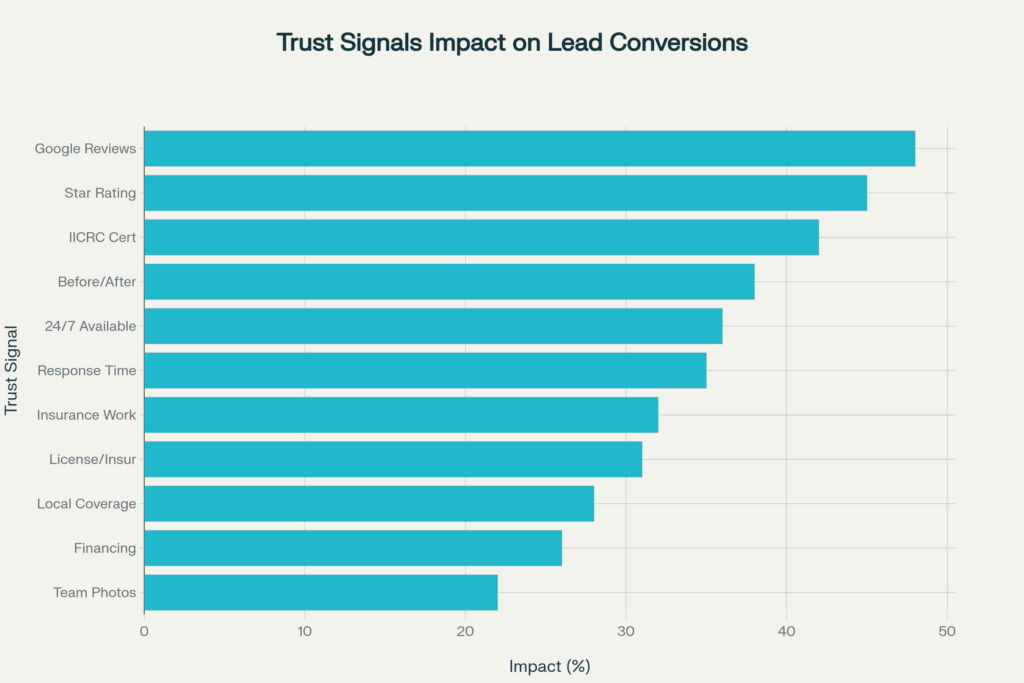
Here are the 10 most influential restoration website trust factors, ranked by their proven impact on lead conversion in the home services industry:
| Trust Signal | Estimated Impact | What It Means to the Homeowner |
| 1. Google Review Count (50+ recent) | 48% | Social Proof/Volume. “Other people trust them, so I can too.” Must be recent; 73% of consumers only trust reviews from the last month [5]. |
| 2. Star Rating (4.2–4.5 Range) | 45% | Risk Reduction. This is the sweet spot. A 5.0 rating often looks suspicious or filtered [6]. A 4.2–4.5 signals excellence and authenticity. |
| 3. IICRC Certification Badge | 42% | Authority/Credential. Required by most major insurers. It signals professional standards and expertise in water, fire, and mold [7, 8]. |
| 4. Restoration Expertise Seal & Certification | 40% | Verified Trust. This badge goes beyond basic training. It shows you’ve been verified against advanced criteria proving superior systems, service, and stability. This is your business differentiation. |
| 5. Real Before/After Photo Gallery | 38% | Visual Proof/Competence. Homeowners need to see the transformation you deliver. Real project photos increase engagement by over 70% compared to stock images [9]. |
| 6. 24/7 Emergency Availability | 36% | Accessibility/Immediacy. Removes doubt. Clearly state that you are available now, not tomorrow. |
| 7. Response Time Guarantee (1–2 hrs) | 35% | Actionable Speed. A lead converts 21x more if they receive a response within 5 minutes. A guaranteed arrival time is a non-negotiable emergency signal [12]. |
| 8. “Works with All Insurers” Badge | 32% | Certainty/Claim Simplicity. Removing the fear of a complex claim process is a massive trust win. Show the logos of major local carriers [13]. |
| 9. License & Insurance Display | 31% | Risk Barrier. A basic requirement, but its visible absence is a monumental red flag. Display clear proof or seals of licensure. |
| 10. Local Service Area Map | 28% | Proximity. “They’re close, so they’re fast.” This instantly reduces the “stranger danger” and reinforces your local legitimacy [9]. |
The Above-The-Fold Blueprint (TACT in Action)
This is where the rubber meets the road. The Above-The-Fold (ATF) section is your digital storefront, it must execute the TACT framework (Trust, Authority, Conversion, Traffic) in seconds.
In an emergency, most searches start on a mobile device. Every element must support the homeowner’s crisis psychology: I need help now, from someone I trust, who is close.
- Sticky Header: This is non-negotiable. It must contain your Logo (left) and a large, high-contrast, Clickable Phone Number (right).
- The Urgent H1 Headline: Must be short, outcome-focused, and signal speed. Example: “Immediate Water Damage Repair – Guaranteed 1-Hour Response.”
- The Authority Sub-Headline: Immediately back up the H1 with your proof. Example: “IICRC Certified, Licensed & Insured. We Handle All Insurance Claims.”
- The Trust Proof Strip: Below the headline, include a row with your 4.5-Star Rating and Review Count (e.g., 87 Google Reviews), with a link to your Google Business Profile.
- Primary CTA Button: The biggest element on the page, often called a “hero button.” It must read “CALL NOW” or “EMERGENCY CALL”. Its color should contrast with everything else.
- Visual Proof: A fast-loading before-and-after photo carousel or a professional image of your certified team member (not stock) [9].
- Reassurance Microcopy: A small line of text reinforcing core value: “24/7 Service. Financing Available.”
This compact, authority-led design ensures that your site passes the “trust test” in under 3 seconds, funneling the homeowner straight to the conversion goal: the phone call.
The Silent Killer: Page Speed & Core Web Vitals
A slow website is a broken trust signal. If your site takes longer than 3 seconds to load the main content, the homeowner’s brain registers you as incompetent, unprofessional, or unreliable, all qualities they are actively trying to avoid in a crisis.
Google’s Core Web Vitals (CWV) metrics are not just SEO theory; they are directly correlated with conversions in local and home services [17].
| Metric | Target Threshold (Good) | Conversion Impact (Emergency Context) |
| LCP (Largest Contentful Paint) | $\le$ 2.5 Seconds | Bounce rate increases by 113% when LCP goes from 1 second to 7 seconds [18]. In a crisis, an LCP >3s is catastrophic, often resulting in an immediate call to the next competitor. |
| INP (Interaction to Next Paint) | $\le$ 200 Milliseconds | Measures responsiveness. Slow interactions feel frustrating and unreliable, directly impacting the perception of your physical response time. |
| CLS (Cumulative Layout Shift) | $\le$ 0.1 | Unstable page elements (things jumping around while loading) feel jarring and chaotic, reinforcing the homeowner’s already anxious state. Layout stability equals trust. |
A site that loads instantly suggests a company with fast, organized systems.
Common Speed Killers on Restoration Websites
Your website may be slow because of common mistakes we see every day:
- Oversized hero images or uncompressed videos.
- Too many heavy Google Fonts or third-party tracking scripts firing before the content.
- Unoptimized before/after carousels that block the rendering of the primary CTA.
To solve this, use WebP compression, lazy-loading for off-screen elements, and ensure your “Call Now” button is one of the very first things to render on the screen.
Crisis Psychology: Speaking the Homeowner’s Language
To win the call, you must design your website to match the homeowner’s state of mind during a disaster.
| Psychology Principle | Homeowner’s Core Need | Website Implementation in Seconds |
| Loss Aversion | Avoid making the wrong choice. | Lead with Authority (IICRC, Restoration Expertise Seal) and Social Proof (50+ recent reviews) before price. |
| Immediacy/Time Pressure | Need help now. | Sticky, clickable phone number and a guaranteed response time in the headline. |
| Proximity | Need someone close and local. | Clearly display your local address and service area map. Local feels safer [9]. |
| Authority Signals | Need certainty and competence. | Visible licensure, insurance logos, and professional photos of uniformed, certified technicians. |
| Social Proof | Need validation that others chose wisely. | Prominent star rating and review count. Real before/after photos are proof in action. |
Action Plan: Winning the Call in 10 Points
This is the ultimate Do-This-Now checklist. Implement these 10 points immediately to optimize your site for emergency job conversion.
- Mobile-First Speed Audit: Target an LCP of $\le$ 2.5 seconds and eliminate all Cumulative Layout Shift (CLS).
- Sticky Header: Implement a fixed header with the Logo (left) and a large, Clickable Phone Number (right) for all mobile views.
- Hero Section Rehaul: Install an urgent, 10-word headline, the 4.2+ Star Rating/Review Count, and the primary “CALL NOW” CTA button.
- Trust Badge Row: Prominently display your IICRC, Restoration Expertise, Licensed, and Insured badges above the fold.
- Schema Markup: Implement LocalBusiness and FAQ schema to boost your visibility and search results footprint.
- Local Proof: Add an embedded Google Map of your office or a clear list of serviced neighborhoods to reinforce local credibility.
- Visual Authenticity: Swap out all stock photography for high-quality, real project before/after photos. Ensure they are compressed to $\le$ 200KB [9].
- Dual CTA Strategy: Use “CALL NOW” (Primary) in the hero section and a secondary “Request Estimate” (Secondary) button below the fold for less urgent inquiries.
- Reassurance Microcopy: Place the key guarantees (“24/7,” “60-Minute Arrival,” “Works with All Insurance”) in the hero and footer sections for maximum reassurance.
- Alt Text & Accessibility: Use keyword-rich, descriptive alt text on all images (especially the before/after photos) for better SEO and accessibility.
Ready to Stop Losing Emergency Jobs?
Winning the call in an emergency isn’t about being the biggest; it’s about being the most trustworthy, the fastest, and the most reassuring option in the first three seconds.
If you know your website is falling short on these crucial restoration website trust factors, but you lack the time to implement them yourself, we are happy to help you building your restoration digital foundation.
Sources
Annotated Bibliography
Web.dev (2024). Vitals Business Impact. Source: https://web.dev/case-studies/vitals-business-impact Note: Provides real-world case studies demonstrating the business impact of improving LCP.
Lindgaard et al. (2006). Attractiveness and Web Usability. Source: https://www.nngroup.com/articles/first-impressions-human-automaticity/ Note: Foundational study on the 50-millisecond first impression judgment of website appeal.
CXL (2024). First Impressions Matter: The Importance of Great Visual Design. Source: https://cxl.com/blog/first-impressions-matter-the-importance-of-great-visual-design/ Note: Supports the rapid-judgment model and 2.6-second attention span on key elements.
Nielsen Norman Group (2024). How Long Do Users Stay on Web Pages?. Source: https://www.nngroup.com/articles/how-long-do-users-stay-on-web-pages/ Note: Provides the 10-second decision-making model and bounce risk timeline.
Shapo.io (2024). Google Review Statistics. Source: https://shapo.io/blog/google-review-statistics/ Note: Provides key data points on the volume of reviews needed and the importance of recent reviews (73% only trust recent ones).
Search Engine Land (2024). How to win at Google Reviews. Source: https://searchengineland.com/guide/how-to-win-at-google-reviews Note: Discusses the “sweet spot” for star ratings (4.2-4.5) to maintain authenticity.
Madison Property Restoration (2024). What is the IICRC?. Source: https://madisonpropertyrestoration.com/what-is-the-iicrc/ Note: Provides context on IICRC certification as an industry authority signal for insurance.
Best Pick Reports (2024). What an IICRC Certified Contractor Can Offer Your Home. Source: https://www.bestpickreports.com/blog/post/what-an-iicrc-certified-contractor-can-offer-your-home/ Note: Reinforces IICRC significance to homeowners and insurers.
Padula Media (2024). SEO for Water Damage Restoration. Source: https://padulamedia.com/seo-for-water-damage-restoration/ Note: Local SEO guide emphasizing the conversion impact of before/after photos and local proof elements.
Hannah Restoration (2024). Emergency Water Damage Response Time. Source: https://hannahrestoration.com/blog/emergency-water-damage-response-time-why-the-first-24-hours-matter/ Note: Reinforces the critical nature of 24/7 service and fast response in emergency jobs.
Scorpion Home Services (2024). Why Speed Wins: The Critical Role of Response Tim. Source: https://www.scorpion.co/home-services/insights/blog/verticals/home-services/why-speed-wins-the-critical-role-of-response-tim/ Note: Quantifies the massive conversion lift (21x) from responding to a lead in under 5 minutes.
Relevant Audience (2024). Core Web Vitals and their impact on SEO Ranking. Source: https://www.relevantaudience.com/seo/core-web-vitals-and-their-impact-on-seo-ranking/ Note: Links CWV performance to business metrics, citing the LCP impact on bounce rate.
Whitespark (2024). Core Web Vitals Local Search Study. Source: https://whitespark.ca/blog/core-web-vitals-local-search-study/ Note: Provides the specific 113% bounce rate increase from 1-7 second LCP relevant to local search.
Frequently Asked Questions (FAQ)
Studies show that leads convert 21 times more if the response time is under 5 minutes [12]. On-site arrival should ideally be guaranteed within 1–2 hours. Your website must clearly state this guaranteed response time to meet the homeowner’s immediacy needs.
Yes. IICRC certification is a powerful authority signal required by many major insurance carriers [8]. Displaying the IICRC badge and, even better, the Restoration Expertise Seal, instantly communicates that your team is trained, professional, and operates with verified processes, which reduces the homeowner’s perceived risk.
Research indicates that star ratings in the 4.2 to 4.5 range are perceived as the most authentic [6]. A perfect 5.0 can sometimes trigger suspicion that reviews are filtered or fake, especially when combined with a low volume of total reviews. Focus on volume (50+ reviews) and recency over a perfect score.
Always use real project photos, especially Before/After galleries [9]. Stock photos feel impersonal and generic. Homeowners in crisis need to see proof of your competence; real photos offer visual proof of transformation and build instant credibility.
Page speed directly affects bounce rate. For every one-second delay in your site’s loading time, your bounce rate can increase by over 100% [18]. In an emergency, slow speed signals incompetence and unreliability, leading the homeowner to quickly choose the next, faster-loading competitor. Your goal is an LCP of 2.5 seconds or less.