You’ve lost the job. The homeowner called, you responded fast, and you gave a fair estimate. You did everything right on paper, yet they chose the other guys. Why?
It’s not always about price. It’s not always about speed. More often than not, the difference between landing a $10,000 dry-out and hearing “we’ll call you back” is something you can’t even see: your Restoration Business Trust Score.
Every customer, every adjuster, and every referral partner runs a quick, subconscious calculation on your company before they ever sign a work authorization. This calculation is your Trust Score. It’s an invisible measure of your credibility, professionalism, and verifiable expertise.
In an industry built on emergencies and high stakes, trust isn’t a nice-to-have; it’s the non-negotiable foundation. If your score is low, you’ll stay stuck in a cycle of fighting for every lead, getting low-balled, and watching profitable jobs walk away. But if you intentionally build it, that score becomes a magnet for the best referrals and the highest-margin jobs.
It’s time to stop leaving your success to chance and start architecting a high Trust Score.
What is the Restoration Business Trust Score, Really?
Think of your Trust Score as your company’s equivalent of a credit rating, but for industry credibility. It’s the sum of all visible and invisible systems that confirm your Experience, Expertise, Authoritativeness, and Trustworthiness (E-E-A-T) to anyone who interacts with your brand.
It’s about separating the professional, process-driven company from the fly-by-night operators.
For the homeowner dealing with a busted pipe at 2 a.m., they are looking for a few key signals:
- Is this company legit? (Verifiable credentials)
- Can they handle my crisis efficiently? (Visible professionalism and systems)
- Will they treat me fairly? (Public reviews and reputation)
A high Trust Score means you automatically satisfy these three critical questions before your boots even cross the threshold. This allows you to focus on the work, not on justifying why you should be hired.
The Three Pillars of Industry Credibility (The Score’s Components)
To improve your score, you have to understand the factors that build it. A strong Restoration Business Trust Score rests on three non-negotiable pillars:
Digital Verification: The Importance of a Credible Badge
Your website needs more than just a list of services. It needs verifiable proof of your commitment to excellence. This is where industry-specific certification comes in.
The Restoration Expertise Certification Tiers (A, A+, B) are designed to provide an instant, recognizable marker of your operational integrity. Earning a higher tier isn’t just about getting a gold star; it proves you meet specific, rigorous criteria—like maintaining a minimum number of five-star Google reviews or adhering to industry best practices.
- B-Tier: Demonstrates basic compliance and necessary licensing.
- A-Tier: Shows commitment to quality, often involving advanced training and proven customer satisfaction metrics.
- A+-Tier: The gold standard, reserved for companies that have mastered both field execution and client relationship management, often indicated by a high volume of positive, recent feedback.
When a client or an adjuster sees this badge, it instantly checks the box for Trust and Authority. It’s the simplest way to gain instant credibility against a competitor who only lists their IICRC certifications on a dusty footer.
Field Execution: Professionalism from the Tires Up
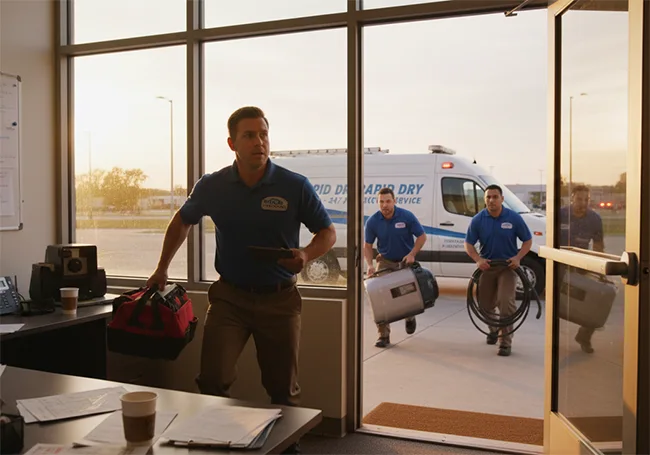
A company truck showing up to a job site is often the first physical impression, and it can tank your score instantly. A truck that is messy, unorganized, or poorly maintained signals chaos and a lack of attention to detail—the exact opposite of what a panicked homeowner wants.
Your professionalism needs to be systematized. This means:
- Vehicle Checklist: Every vehicle should be stocked, clean, and organized according to a non-negotiable checklist. (Reference the knowledge base insight on What Should I Put on My Restoration Truck?—it’s about systems, not just stuff).
- Uniformity and Appearance: Clean, branded uniforms signal you are a legitimate operation, not just a contractor who wandered in.
- Standardized Contracts: Using clear, attorney-reviewed documents like a proper Work Authorization and Reconstruction Agreement (as discussed in the knowledge base) ensures clarity and fairness, eliminating doubt and making the client feel secure. When your systems are tight, your score rises.
Client Perception: Closing the Five-Star Gap
The third pillar is what the community says about you. In the age of the Google Three-Pack, your public reputation is the single fastest way to build or destroy your Trust Score. If you have 100 five-star reviews, that volume signals Authority and Trust almost instantly.
But it’s not just the number of stars; it’s the consistency and the quality of the review that matters. Did you get a good review because you showed up on time, or because you showed true empathy and expertise while handling a complex insurance issue?
To close the gap, you must treat the collection of reviews as a formal, integrated step in your process, not a hopeful afterthought. A strong Trust Score requires you to ask for reviews and, more importantly, to respond to every one of them—positive or negative—to show you care about your client community.
Audit Your Score: The Three Warning Signs of Low Trust
How do you know if your score is currently hurting you? Look for these three clear warning signs:
Warning Sign 1: You Only Win on Price If your primary competitive advantage is being the cheapest, your Trust Score is dangerously low. Customers are only willing to gamble on a low-cost provider when they have no confidence in the higher-priced, more established option. A high Trust Score allows you to command a fair margin because your verified credibility justifies the investment.
Warning Sign 2: Referral Partners are Inconsistent Are you getting high-quality, pre-sold referrals? Or are your relationships with plumbers, agents, and property managers flaky? Referral partners only stake their own reputation on a company with a strong Trust Score. If they don’t see your systems, your professional presentation, and your commitment to client experience, they will send their best work elsewhere.
Warning Sign 3: You Have Trouble Getting Paid The knowledge base notes that many contractors struggle to get paid by major carriers like State Farm and Allstate. This often happens because they don’t know the holes in the system or they lack the proper, standardized documentation. A high Trust Score, backed by meticulous system documentation and professional contracts, drastically reduces friction in the claims process, making payments smoother and faster.
Action Plan: Boosting Your Trust Score for Consistent Referrals
Boosting your Trust Score isn’t about expensive marketing; it’s about disciplined, systematic internal changes.
- Implement the 99-Step Blueprint: This detailed process, often associated with achieving a high certification tier, provides the framework for operational excellence. It ensures that critical steps—from initial call to final invoice—are never missed, minimizing errors that erode trust.
- Audit Your First Impression: Walk out to your trucks right now. Is the exterior clean? Is the interior organized? Do your crews look professional? Set a zero-tolerance policy for messy vehicles and non-uniform attire. Remember the contractor who lost the $40K job simply because his crew looked unprofessional on arrival—the first 30 seconds dictate the whole job’s perception.
- Standardize Your Paperwork: Use the professional agreements and moisture logs from the knowledge base. Stop using informal, handwritten notes. When you present an adjuster or a homeowner with meticulous, standardized documentation, your Expertise and Authoritativeness score skyrockets.
- Connect with Captive Agents: The knowledge base highlights that Captive Insurance Agents (like State Farm or Allstate) are often the easiest to work with and represent the biggest carriers. They are predictable. Building a relationship with them—not just fighting the process—is a huge win for your Trust Score, as it shows you know how to operate within the established system.
Ready to stop fighting for every job and start attracting the work you deserve?
Are your current systems truly built to earn trust, or are they just built to survive the next call?
You can see immediate improvements by cleaning up your public image (trucks, uniforms, website) and standardizing your contracts in a matter of weeks. However, the most significant increases, like achieving a high-level certification or reaching 100+ positive reviews, are systems-based and require 6 to 12 months of consistent effort and discipline.
The most common mistake is focusing exclusively on the technical work (the dry-out) and neglecting the customer experience. Failing to communicate clearly, delaying documentation, or showing up in an unprofessional state all signal poor management and a lack of respect for the client’s crisis, destroying trust.
The Trust Score is the direct outcome of successfully implementing the TACT (Trust /Authority/Conversion/Traffic) and SVAC frameworks. Trust is the foundation of TACT, while Structure and Authentic Presence (from SVAC) are the operational pillars that produce the verifiable proof needed to earn a high score.
Absolutely. A high Trust Score is not about size; it’s about systems. A small, highly professional team using standardized documents, keeping their single vehicle immaculate, and providing exceptional customer care will always have a higher score than a large, sloppy operation with high employee turnover.
Yes. While major carriers are predictable, they require accurate, timely, and professional documentation. A low Trust Score often comes with disorganized paperwork and inconsistent processes. This gives adjusters and desk reviewers reasons to delay, challenge, or reduce your invoice, whereas a highly professional package is often paid out faster.