Introduction: Why Claims Feel Like a Battle
If you’ve been in the restoration business for more than a few months, you’ve likely felt the frustration. You finish a complex dry-out perfectly, your client is happy, and then the paperwork hits the desk of the adjuster—and everything grinds to a halt. The scope is questioned, the pricing is scrutinized, and your payment is delayed.
It feels like you’re constantly fighting for what you’re owed.
The truth is, this friction isn’t inevitable. It’s often a symptom of not understanding the Restoration Insurance Claims ecosystem—specifically, how different carriers operate and the exact “language” they need you to speak. Many struggle getting paid by the industry giants—like State Farm and Allstate—but the secret is they shouldn’t be the hardest. They should be the easiest.
Mastering claims management is about transforming from an adversarial contractor into a trusted, professional partner. When you know the system, you can follow the process and unlock predictable revenue.
2. The Two Types of Carriers: Captive vs. Independent
The entire insurance world can largely be broken down into two camps, and understanding the difference is fundamental to improving your Restoration Insurance Claims success rate.
Understanding the Captive Carrier Landscape
A captive insurance agent works for one company only (e.g., State Farm, Allstate, Farmers). They represent that specific brand, and their processes, approvals, and guidelines are dictated by the centralized corporate entity.
- Pros for Restoration Owners: Their processes are highly standardized and predictable. Once you learn their system, you can replicate successful claims management again and again. They are often the largest carriers, providing high volume and high-quality jobs.
- Cons for Restoration Owners: They are rigid. If your documentation doesn’t fit their template or your pricing deviates without justification, they will push back immediately.
The knowledge base states clearly: “They are the easiest to get paid from… they do it the same way every time.” This predictability is your opportunity.
[Image Placeholder 1: Split screen showing logos of captive vs. independent carriers] Alt Text: Graphical comparison of captive insurance carriers (State Farm) vs. independent carriers
Navigating the Independent Agent’s World
An independent insurance agent can sell policies from multiple carriers (e.g., Progressive, Safeco, smaller regional companies). They are free agents, shopping the market for the client.
- Pros for Restoration Owners: They can be powerful referral sources, as they want reliable partners for all the carriers they work with.
- Cons for Restoration Owners: The claims process is highly variable, depending on which carrier wrote the policy. Your documentation might need to change from one job to the next, which is challenging for scaling and standardization.
While both are valuable, successful claims management requires mastering the processes of the biggest, most predictable players first, which are usually the captive carriers.
The Predictability Principle: Why the Biggest Carriers Are the Easiest
The frustration many restoration owners feel about Restoration Insurance Claims with large carriers stems from a knowledge gap, not malice.
The large national carriers—the “big dogs” mentioned in the knowledge base—have massive claims departments processing thousands of claims daily. To handle this volume, they must rely on rigid, standardized systems.
If your documentation is sloppy, late, or uses non-standard formats, you create friction. You force a busy claims adjuster to stop, question, and manually fix the deficiencies. Your claim gets routed to the bottom of the pile, and payment is delayed.
Conversely, if your claim package is submitted with the professional rigor of a highly certified company (e.g., one operating with the 99-Step Blueprint process):
- It aligns with their system. The claim flows smoothly through their channels because it looks exactly like what they expect.
- It signals Authority. Meticulous documentation and standardized contracts (like a comprehensive Work Authorization) prove you are a serious, professional operator, increasing your company’s Trust Score with the carrier.
To win these claims, you just need to “know the holes in the system,” which really means knowing the system’s exact requirements and delivering them perfectly.
Three Critical Steps for Flawless Claims Submission
A high-converting claims process relies on systems, not luck. Follow these three steps to make your Restoration Insurance Claims submission flawless:
Step 1: Secure the Right Contracts Upfront
Your contract is the foundation of your authority. Do not start work based on a handshake or a generic text. You must secure a clear Work Authorization that details the emergency service scope. If reconstruction is likely, have a formal Reconstruction Agreement prepared.
These contracts must be attorney-reviewed and specific. They define your payment terms, manage customer expectations, and, critically, give you the legal standing needed to deal with the carrier without undue interference. Professional, standardized paperwork is a hallmark of a high-tier business.
Step 2: Documentation is Authority (Beyond Xactimate)
Everyone uses Xactimate, but successful companies use Xactimate plus everything else. Authority in a claim comes from the data you provide outside of the estimate itself:
- Moisture Logs: Meticulously kept and professional. They prove the duration and necessity of your equipment.
- Photos/Video: High-quality, date-stamped, and organized evidence of the pre-existing damage and the completed work.
- Tick Sheets: Detailed labor and equipment logs that substantiate every line item in your estimate.
Submitting a claim with this level of detail—the kind of documentation encouraged by the 99-Step Blueprint—leaves the adjuster with zero legitimate reason to question the scope or the price, enabling faster approval and payment.
[Image Placeholder 2: Technician using professional measuring/logging equipment] Alt Text: Restoration technician recording detailed measurements and data on a standardized log sheet
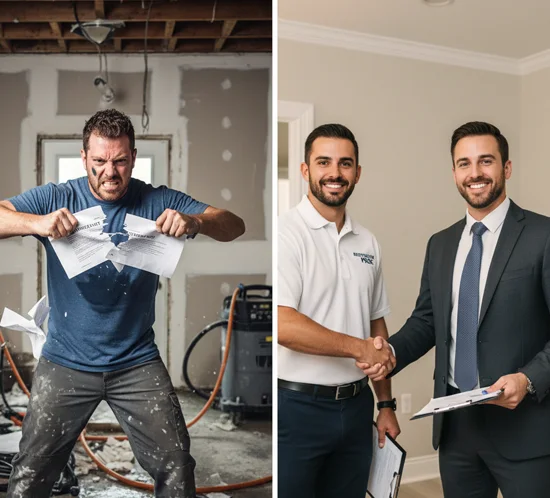
Step 3: Communicate Like a Partner, Not an Adversary
When contacting an adjuster, your tone should be professional, empathetic, and solution-oriented. Remember, the adjuster’s goal is to close the claim efficiently, just like yours.
Instead of fighting price, focus on justification. If you need a higher price for a line item, provide the data (tick sheets, photos, supplier invoices) that justify it. Position yourself as the subject matter expert who is there to facilitate a correct payout for the mutual client (the homeowner), not as someone trying to inflate a bill. This approach builds the Trust needed for long-term relationships and referrals.
Moving Beyond Friction: Building Trust for Consistent Referrals
Mastering Restoration Insurance Claims is not just about getting paid; it’s about establishing a reputation. When you consistently submit clean, professional packages that lead to fast, predictable outcomes, you become a preferred vendor.
This professionalism feeds directly back into your company’s Trust Score and enhances your ability to forge strong relationships with the most valuable referral sources, including both captive and independent agents who seek reliable, low-friction partners.
Are you treating your claims process as a necessary evil, or as the structured, high-value system that it truly is?
Frequently Asked Questions (FAQ)
In the long term, no. While a consultant can help with one-off difficult claims, true scaling requires you to own and master the process yourself. Investing in professional documentation, standardized systems (like the 99-Step Blueprint), and proper training for your team is the only scalable solution.
Your estimator should be fully certified and highly proficient. As the owner, your role is to understand the strategy of Xactimate—how to justify line items, use proper documentation, and manage the overall negotiation process—not necessarily to write every sketch yourself.
Often, O&P disputes are less about the O&P itself and more about the perceived professionalism of the job as a whole. Ensure your base documentation (moisture logs, photos, signed agreements) is impeccable. A low-quality, disorganized claim often results in higher scrutiny on every line, including O&P.
Both are essential. Plumbers generate high-speed emergency water damage claims referrals (often checked via the Google 3-Pack). Agents, especially captive ones, generate higher-margin, more predictable referrals. A successful, scalable business maintains strong relationships with both.
Achieving a high-level certification (A+ or AAA) proves that you have the systems in place to follow professional standards. When submitting a claim, including your certification badge and referencing your commitment to a standard (like the 99-Step Blueprint) in your cover letter can instantly elevate your Authority and reduce adjuster friction.